November 24, 2021

The Kindred Spirit


Yesterday, a friend took me on a long beach walk to visit a spot known as the Kindred Spirit.  It sounds as though it might be a bar, but it’s not!  Instead it is a mailbox on an ancient weathered post tucked into some dunes with two benches nearby. Inside the mailbox are several notebooks and a handful of pens.  People who visit write whatever messages they want/need and leave them.  I wrote in one of the books, a note about gratitude for my visit and the blessing of sea and sky and brisk breezes.  


Visiting there reminded me of a story I listened to on “This American Life” about a phone booth in Japan. After the 2011 tsunami, people came there to call their loved ones who were swept away, never heard from again, never found.  The phone is not connected to anything … except hope, memory, grief, love. Those who come dial remembered phone numbers and speak into the wind. The Kindred Spirit wasn’t quite like that, but the messages people left, including mine, were offered up to whomever, to the universe, to God.  


November 8, 2021

Last Suppers and First Meals

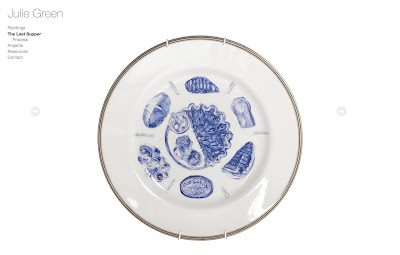
Julie Green, an artist who died in October, painted white ceramic plates with depictions of the last meals of inmates about to be executed. She started her project to call attention to capital punishment. The images are beautiful, blue on white, and poignant. She called the collection “The Last Supper.” 

Her obituary includes some of the stories behind the meals. I suppose all the stories are tragedies: lives lost to violent crimes, lives spent with the trauma and mourning of those losses, lives spent in prison, a waste all round of one of the Creator’s greatest gifts. But one story in particular struck me as almost unbearably sad. “In Georgia in 2009, a mentally disabled inmate asked for half a pecan pie. He didn’t understand the concept of execution, and he intended to save some of the pie to eat afterward.” I don’t know what crime this man committed, what horrible act destroyed his life and the lives of unknown others. But he was not able to comprehend his own death, and I wonder if he knew what he had done, if he could participate in his own defense, if there was a point in his life when someone might have been able to save him – and thus save his victims. I don’t know.
https://greenjulie.com/last-supper/


Ms. Green did not stop with paintings of the last suppers. She also painted some “first meals,” what the newly exonerated chose to eat when they were freed. “Working with the Center on Wrongful Convictions at Northwestern University’s Pritkzer School of Law, she reached out to recent exonerees like Jason Strong, who had been convicted of murder. His first meal, ordered at the diner near the prison where he had been incarcerated for 15 years, was a cheeseburger with bacon and mushrooms. As he waited for it to appear, he talked about how much he loved oranges, a fruit he had been denied while he was in prison. A waitress overheard him and brought one from the kitchen. He spent 40 minutes just holding it, turning it over and over in his hands.” 

How much I take for granted: safety, intellectual ability, personal protection, freedom, food, life itself. And oranges.


November 6, 2021

Root-Bound

Just weeks before the pandemic shut down the world, we moved back into our house following a major (and lengthy) renovation. We had planned a big open house for friends and neighbors, but that was not to be. We were able to have a thank you party, though, for those who had worked on our old house, even with boxes all around and without much of the furniture in place. One of the guys came with a small plant, an anthurium, in a little red pot. In all the to-do of the party, I just set the pot on the window sill over the sink. And there it stayed for months and months and months. It was in a convenient place for watering, and it got good sun. But after a while it stopped growing and it stopped blooming. It was badly root-bound. A while back I decided to repot it. With its roots loosened and fresh soil, and in a new sunny spot, it began to grow and put out new shoots that started blooming. 

And I think that so many churches are like that little anthurium – they have become root-bound. It is so comfortable and convenient to stay the same, do things the same way, avoid the kind of uprooting that change can bring. Those churches may not die but they don’t grow either. They don’t flourish. They don’t bloom. 

The pandemic has kept us all in place. Now that the threat seems to be easing, maybe it is time to repot, to change the things that have hindered growth, to look for new ways of being. This is hard and disruptive and often painful. It is so much easier to keep on with what we were doing before the pandemic. But the stark reality for many churches is that if they can’t change, if they can’t spread their roots into new soil, if they can’t enlarge their vision beyond their own s(pot), they will die -- maybe not overnight, but eventually. But those who can be honest about the past, who can do the hard and messy work of repotting themselves, the ones who can change, may just start to thrive and grow and bloom again. May it be so!

Anthurium in a new pot and a good sunny spot!


November 2, 2021

Connections...


Our friend buried her horse at the farm last week. He was very old and very sick, and it was really sad. There is a special connection between horses and their people, and he had been with our friend for a long time.  

And I am reminded that in the beginning, “God brought [the animals and the birds] to the man to see what he would call them; and whatever the man called each living creature, that was its name. The man gave names to all cattle, and to the birds of the air, and to every animal of the field.” (Genesisv2:19b-20a) When we name a creature, we bind ourselves to it. It becomes in our eyes what it has always been in God’s eyes – precious. And in the naming, we are connected. Although it might be better to say that we are made aware that we are already and always connected. We are all part of God’s creation, God’s created: humans, animals, birds, fish and sea creatures, plants and ferns and amoeba – everything living. 

We are all connected, but some of those connections are stronger and more powerful. We wept with our friend. The man who came with the backhoe to dig the grave made a cross of small branches, and my sister cut flowers.  And we were glad that she came to this place to lay her horse to rest. She wanted a place where she could return, and she knew we would always be here. We are connected to this farm, and now, so is she.


October 18, 2021

The Writing Spider


She built her web in the most precarious fashion, a few strands attached to the door of the chicken’s feed room and those on the other side connected to the mountain mint growing by the door. Every time I opened the door, I took care not to detach the web. And she spun and wrote and the web stayed intact. (She was a yellow garden spider, Argiope aurantia, also known as a writing spider.) And then one day, she was gone. The web was still there, but she was not. I thought maybe a bird had gotten her. But no: A few days later, another web appeared, a few feet from the first, but this one in a more stable location. And there she was – I’m sure it was the same spider – weaving and writing away. The nights are cool and the days are shorter, and I think she is getting ready to leave some egg sacs for next year. 

And from the spider, I try to learn the lesson of waiting and hoping. In Hebrew, that is the meaning of the word qavah (Psalm 130:5-6). And it also means stretched out, the tension of pulling from both ends. It can mean strength, the kind of strength that comes from a rope made of twisted cords. And it has the same origin as the word for a spider’s web. 

Ounce for ounce, the fiber of a spider’s silk is one of the strongest materials that exists – 10 times tougher than Kevlar which is used to make bullet proof vests. Medical researchers have discovered healing powers in the spider’s web. And the construction of a web is an amazing thing to watch. How does a spider know measurement and design and geometry? Why do different species build webs of different designs? How did that fragile web survive when it was anchored to a door that got opened and closed every day and a plant that swayed in the breeze? It is all a miracle. 

And this miracle is a kind of parable for human waiting and hoping. I do a lot of that these days, waiting and hoping for a safer world, an easing of the pandemic, a return to sanity in our body politic. And I feel at times like that spider, in a most precarious fashion. What does she teach me? Maybe to anchor myself in the present, even if it feels like a moving target; to weave a strong web of prayer and support to sustain myself in the hard times and the good times; to hope for God’s healing power; to wait for what God will provide. 

Frederick Buechner has said we are to go where our best prayers take us. For me, maybe that means connecting myself to the source of faith, no matter how fragile and wavering it seems, and then casting off into the unknown guided by a thread of prayer, remembering that my prayers are both fragile and tough, always beautiful, guided by God, created in my soul. Waiting and hoping, holding to a thread, praying for a landing place, weaving a web of faith and hope and love.


The first web, falling into disrepair,
but still attached!!


October 9, 2021

The Church

In March 2020, days after our part of the world came to a screeching pandemic halt, I officiated at a wedding – in the backyard, five people present. Last night, I led that couple in a renewal of their vows. This time, they had a ceremony with their attendants, a lovely reception and family and friends around them. And their four-week-old son was nearby! 

We gathered in a lovely old building that has been turned into an arts center. Lots of events, including weddings, are held there. The building dates to 1889, when it was constructed to house St. Andrews Presbyterian Church. That church long ago merged with another Presbyterian church in town, but the building remained with the name above the door and an old Sunday School chalkboard in one of the event spaces. Alexander McClure was the minister for many years; he was active in the community and highly regarded. When he died, the businesses in the whole town closed so everyone could pay respects as his funeral procession passed. He also established ministries beyond St. Andrews. One of them, founded in 1926, was named in his memory: McClure Memorial Presbyterian Church. I was the pastor there for just over four years. There was a picture of him hanging in the hallway at the church. 

And there is a picture of him at the arts center – hanging over the bar. I wondered last night what he would think about that, and about that place where he preached all those years now hosting weddings and fancy parties. 

And I thought that maybe the spirit of the church was still in that place. There was so much love and joy present there. People were looking after each other -- loving their neighbors -- by wearing masks and being careful. We shared bread and wine (and cake!). There were laughter and tears, story-telling, remembering. There were prayers and blessings. It wasn’t a church, but somehow it was still church – people gathered in love, offering thanks for God’s gift of marriage, giving and receiving blessing. 

Sometimes people come to the church (the building), but more and more I think, the church needs to come to the people. Last night, I felt that I brought the church to the people, in that old once-consecrated space that was yet again made holy by Love.


Sunday School attendance board


The Rev. McClure's portrait hanging in the bar.....


October 4, 2021

Ministry

October 4 – today – is the 23rd anniversary of my ordination to the Ministry of Word and Sacrament. Some years I have had a quiet day of personal retreat to reflect on ministry, what God has called me to in the past and what new call might be emerging. I did not do that this year. 

October 4 is also the feast day of St. Francis. And today my ministry was less about the church and more about animals. The horse is lame and has to be dosed twice a day. The dog is on meds for neurological issues. One cat is just back from the hospital and is isolated from the rest. Another cat is on anti-depressants for stress. So I have spent time today caring for our animals. And there is ministry in that, too. 

I am thankful for all the ways my calling has stretched and challenged and blessed me. I am grateful for the churches I have served. I rejoice in the blessing of having a ministry in place, in a place that I love, with people that I love. And animals!


October 1, 2021

The Cross is Everywhere....


Moss growing on the back steps 
leading into the sanctuary where I preach
 

September 28, 2021

A Lack of Love...

NY Times, 9-25-21, data for Pender County


Every week we hear about someone who has gotten sick with Covid-19. People we know have been in the ICU for weeks and weeks. Some have died. It is heartbreaking. And part of what makes all this so tragic is that it does not need to be this way. 

Vaccines have been available since January – nine months, but just over half of the people in our county are fully vaccinated. The school board had required masks at the traditional start of the school year due to extraordinarily high rates of infection at the year-round school. But they voted to make masks optional starting October 4. One of the members said it was a matter of “freedom,” allowing families the right to choose what was best for them. 

I would rather be free of worrying about my mother getting sick. I would rather be free to go into a store where people were protecting others by wearing masks. I would rather be free to see friends again. We used to say that one person’s freedom ended where another’s nose began, but clearly a large minority of people in my county don’t practice that. 

And here is an irony: Many of those who refuse to wear masks and won’t get vaccinated profess to be Christian. Jesus said that one of the greatest commandments is to love your neighbor as yourself. But for many here, love of self, love of one’s own preferences and comfort, and love of personal privilege have overruled love of neighbor. It makes me sad. And it also makes me angry….


September 25, 2021

Sunday Driving


It seems hard to imagine, but folks once went driving, often on Sundays, just for fun. Piling in the car and slowly motoring along, they saw the sights, explored back roads, took their time. “Sunday driver” is now a pejorative term – someone who creeps along and holds things up. Our vehicles are utilitarian vessels, hurtling us from here to there as quickly as possible. They are not usually meant for pleasurable outings. We are all in hurry, and if you don’t believe that, try driving the 70-mile-an-hour speed limit on I-40!  

My sister and I did some Sunday driving this week. We took my 1949 Ford pickup to church. There are no seatbelts or turn signals, no AC, no radio, no automatic windows. Starting it involves turning the key, pulling out the choke, and pressing the starter. Top speed is under 40 mph. It slowed us down. We had some time to talk. The air blowing in the window was warm and sweet. There weren’t many others on the road so no one was blowing a horn and racing past us. It was a lovely little trip, a brief interlude of Sabbath grace.